
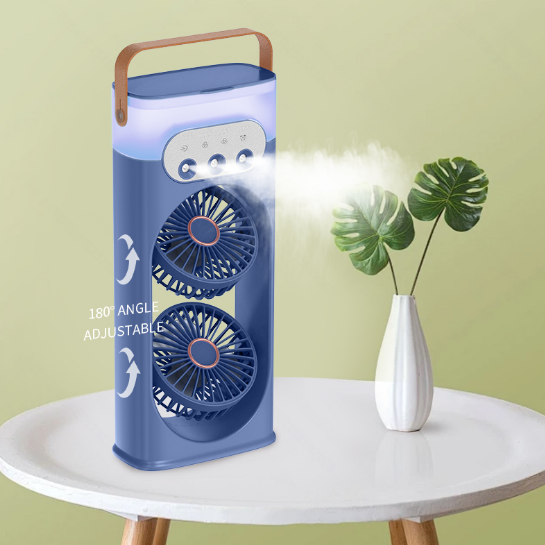
Quick answer: buyers evaluating a compact misting fan should start with the use case and then compare airflow, mist delivery, water management, battery and charging, controls, materials, cleaning, packaging and model-specific evidence. A feature list alone is not enough to approve an OEM/ODM project.
Start with the operating scenario
A personal handheld product, a desk fan and a compact outdoor unit solve different problems. Define who will use the fan, the expected operating environment, how the water tank will be filled and cleaned, and whether the buyer needs a promotional item, retail product or repeat-order programme. This narrows the relevant models in the portable fan catalogue.
Evaluate airflow and mist as separate functions
Air movement and mist delivery should be reviewed independently. Confirm the speed-control method, intended airflow range and noise expectation. For the mist system, review tank capacity, atomization method, nozzle position, sealing, residual water and cleaning access. Ask for evidence from the exact model and configuration; a demonstration from another product should not be used as a substitute.
Review battery and charging information
- Record the battery type, rated capacity and configuration.
- Confirm the charging connector, input requirements and included cable.
- Separate target runtime from verified runtime and record the test condition.
- Check label, manual and transport-document requirements for the destination market.
- Control changes to the cell, protection board or charger after sample approval.
Battery information is configuration-specific. Buyers should keep the approved battery record linked to the model, sample and purchase specification. Yobonjee explains its evidence boundaries in the product data and documentation policy.
Use samples to close open specifications
A sample review should record more than appearance. Check control logic, speed sequence, charging indication, mist output, leakage after transport orientation, cleaning access, stability, surface finish, printed marks and accessory completeness. Photograph the tested sample and keep a revision identifier so later production checks refer to the same configuration.
Define customization without losing control
| Customization area | Buyer input | Approval record |
|---|---|---|
| Color and finish | Color reference and surface expectation | Approved sample or signed color limit |
| Logo | Vector artwork, size and position | Artwork proof and physical sample if required |
| Packaging | Box structure, artwork, labels and barcode | Print proof, pack-out and carton information |
| Manual | Language and required warnings | Final controlled PDF and revision |
| Accessories | Cable, stand, strap or spare parts | Approved bill of materials or packing list |
Assess supplier evidence and project responsibilities
Ask which party owns the specification, sample approval, test evidence, artwork, inspection and corrective-action process. Confirm that business and production information applies to the proposed resource and model. Avoid relying on generic claims about factory size, employee count, certifications or capacity without current, attributable evidence.
Yobonjee supports sourcing and OEM/ODM project coordination with qualified manufacturing resources. Production location, capacity and compliance scope are confirmed for the selected project rather than presented as universal company facts.
Build the inquiry around decision-ready facts
- Identify the use case and preferred format.
- List required performance and control functions.
- State battery, charging and runtime expectations.
- Define customization, packaging and document needs.
- Provide quantity, market and target timing.
- Mark unverified items as open instead of turning them into claims.
Send the product reference and the completed brief through the model-specific quotation form. The reply can then distinguish confirmed data, target requirements and points that need sample or document review.
Maintain a change record after approval
The approved sample should remain connected to a dated specification, artwork set and packing record. If a component, battery, control program, nozzle, material or package changes, record the reason and assess whether the buyer needs a comparison sample or repeat check. This makes later orders easier to review and prevents an unrecorded change from being presented as the originally approved configuration.
Frequently asked questions
Is the highest speed count always the best specification?
No. Control resolution should be considered with usable airflow, noise, runtime and the intended application.
Can one sample approve every future configuration?
No. A material, battery, firmware, accessory or packaging change may require a new approval or a documented comparison.
What should remain open at the inquiry stage?
Any value not supported by the exact model or an approved buyer requirement should remain clearly marked as pending confirmation.