
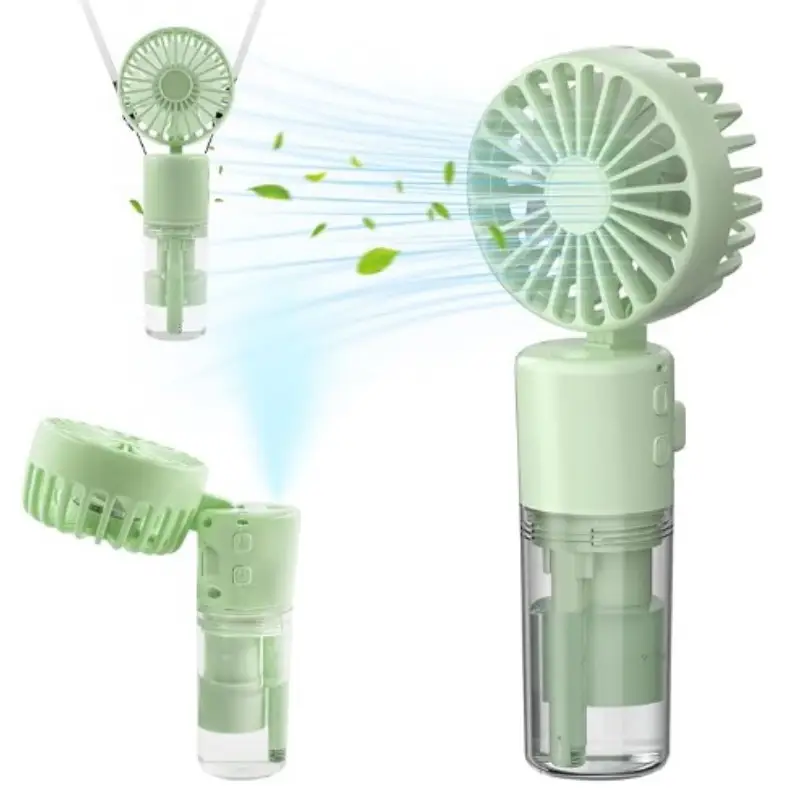
Quick answer: a portable misting fan OEM/ODM project should move through six controlled stages: use-case definition, model screening, supplier-resource review, sample approval, packaging and document confirmation, and commercial quotation. Each claim should remain tied to the selected model, configuration, source and date.
Define the buyer and market requirement
Start by identifying the sales channel, end-user scenario, destination market, expected order quantity and target timing. A promotional handheld fan, a travel product and a compact desktop model can require different durability, battery, packaging and labeling decisions. Review current formats in the Yobonjee portable fan catalogue.
Screen models against a written specification
Use a comparison sheet that separates required, preferred and open items. Record dimensions, weight, fan structure, speed controls, display, mist method, tank capacity, battery, charging, accessories, materials and packaging. Do not copy an unverified value from a visually similar model. If a parameter has not yet been checked, label it as pending confirmation.
Review the proposed manufacturing resource
Supplier-resource evaluation should cover business identity, relevant product experience, sample response, change control, inspection cooperation, document traceability and communication. Production capacity, certification and production-site information should be requested for the actual resource and project. Generic ownership wording is not a substitute for attributable evidence.
Yobonjee’s public role is portable-fan sourcing and OEM/ODM project coordination. Qualified manufacturing resources are selected according to the model and requirements; Yobonjee does not publish unsupported claims that every catalogue item comes from a company-owned factory.
Control the sample and approval process
- Create a sample brief with the model, configuration and requested changes.
- Record product markings, battery information, controls and included accessories.
- Test airflow, mist operation, leakage, charging and runtime under stated conditions.
- Review finish, logo, color, packaging and manual artwork.
- List deviations and decide whether a revised sample is required.
- Keep photographs, files and approvals under one revision reference.
Separate documents by purpose
| Document group | Purpose | Control point |
|---|---|---|
| Product specification | Defines the approved configuration | Model and revision must match the order |
| Battery information | Supports product and transport review | Cell and pack configuration must match |
| Compliance evidence | Supports destination-market assessment | Scope, model and validity must be checked |
| Artwork files | Controls logo, labels, manual and box | Final approved version must be identifiable |
| Inspection record | Documents agreed checks and results | Acceptance criteria must be defined in advance |
Documents are not universal promises. The importer or a qualified local party should confirm current destination-market requirements for the exact product. See the documentation and evidence policy for Yobonjee’s publication rules.
Plan packaging and logistics early
Packaging affects protection, retail presentation, carton volume and landed cost. Confirm the unit pack, accessory placement, barcode, manual language, shipping marks, units per carton, carton dimensions and weight. For battery-powered products, align packaging and logistics planning with the confirmed battery configuration and shipping route.
Compare commercial offers on the same basis
A controlled quotation should identify model, configuration, quantity, unit-price basis, trade term, sample or tooling charge, payment milestones, lead-time assumptions, packaging scope, inspection arrangement and validity period. An offer with missing scope is not directly comparable to a fully defined quotation.
Keep evidence usable for repeat orders
Store the approved specification, sample photographs, battery record, artwork, packaging information and inspection criteria under one project reference. On a repeat order, verify which items are unchanged and which require a fresh check. Evidence without a model, configuration, source and date can be difficult to rely on, so the record should make those boundaries explicit.
Internal links for the next buying step
- Review pricing and MOQ variables.
- Use the buyer-confidence checkpoints for due diligence.
- Choose a model from the handheld fan category or the full catalogue.
- Send the controlled brief through the Request a Quote form.
Frequently asked questions
Does OEM/ODM mean every feature can be changed?
No. Feasibility, MOQ, tooling, testing and timing depend on the selected base model and requested change.
Who confirms import compliance?
The importer or a qualified market specialist should confirm current requirements. Product evidence must be checked for the exact model and configuration.
What information produces the fastest quotation?
Provide the product reference, quantity, destination market, required functions, customization, packaging, documents and timing, and clearly mark any open decisions.